

Publication date: September 21, 2021
A Sunday at the Ruta Olive Mill, where Giorgio Ruta, master miller from Castelluccio, in the province of Syracuse, preserves and passes on the ancient art of olive oil with a bold and visionary project.
“Ciccio, will it rain tomorrow?” The atmosphere is tense at the Ruta Olive Mill, a mecca for seekers of green gold spread across the hills of Castelluccio. “It seems so, but only tomorrow, Dad,” Ciccio replies with a furrowed look. One rainy day is not enough; a lot of water is needed to bring the olives to the right ripeness, explains Giorgio Ruta, who has been running the family mill for forty-one years. “The olive tree is an exception of nature. It’s a selfish tree; it refuses to suffer. If it rains little, it abandons its fruit to the ground and the year is lost.” So the machines shine, the workers are ready to celebrate the oil harvest, but no one is yet at the mill.
An immense belt of centuries-old olive trees surrounds the mill, where three generations of the Ruta family were born and raised. Hanging on the white walls of the building are family photographs, bottles of all shapes and colors tightly packed so they don’t fall from the shelves. Through the windows of the administrative office where Graziana, Giorgio’s eldest daughter, works, you can glimpse the heavy crown of medals the mill has won over the years. “My father built it in 1953; I spent my childhood among machines, olives, and oil. Back then, production was very different; working in the mill was very hard. I immediately felt this would be my life. When I graduated, my father gave me the keys: ‘Now it’s your responsibility, the business is yours.’”
As he speaks, Giorgio sniffs the wind and nervously rubs his large dark hands. His direct gaze and clear ideas strike me. “I immediately chose the path of quality. I imposed very strict rules on the growers: timing, harvesting method, transport, everything. I no longer accepted compromises: those who didn’t respect them couldn’t enter the mill. The first year I lost over 50% of customers; it was very tough. But in the long run, these choices paid off. After a very difficult initial period, we started growing year after year. Today we have six hundred and thirty customers; the largest companies in the area come to me to mill and ask for advice. And together we win awards and mentions.” A choice that has borne fruit, especially now that competition from foreign markets has become fierce.
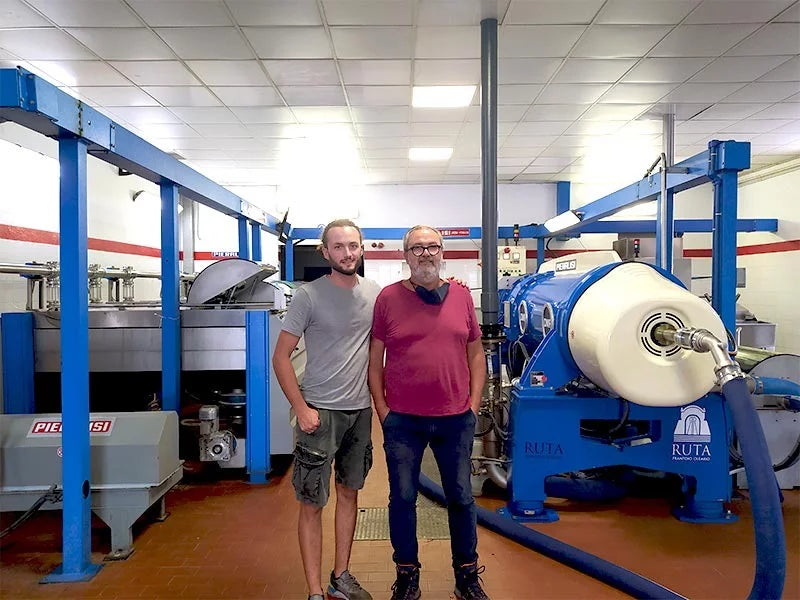
Ciccio stands up, talks with the workers, checks the machines and the schedule. He is present. Thin, with a quick gaze and skilled hands, though young, Ciccio is the expression of that new generation eager to learn and with a wild desire to innovate. From his movements, I understand that the Ruta family has oil in their blood. “Ciccio lives for the oil; he spends the whole day here. Without passion, you can’t do this job. You have to feel the miller’s work inside.” Inside, Giorgio also has the sound of the machines: “I wanted the bedroom in front of the mill so I can hear them and understand if everything is working well.”
I wonder how there is still room for innovation in such an ancient art. “See those two machines? They are the crushers; I got two so as not to overheat the olive paste. I convinced the manufacturer to modify the production line; today he also sells this solution to other mills.” Technology and experience, experience and technology, he keeps repeating while looking affectionately at Ciccio who, despite nine years in the mill, still cannot manage the separator alone, a crucial point in the transformation process. “Either I or my partner is there; a few moments more or less and the oil isn’t perfect. Ciccio is learning fast; soon he will be on his own too.”
An elderly man interrupts us, looking for Giorgio. “He lives just a little further on; sometimes he brings me a chicken, and I repay him with oil. We are a very close community; for those who live here, the mill is a point of reference.” Here, he explains to me, it becomes community, but also culture: “In the past, we organized events to talk about oil. It wasn’t Covid that stopped them, but the rudeness of some people who left a long trail of degradation and garbage when they came to the mill.” A problem that, unfortunately, goes beyond the mill and that, like all those he meets, Giorgio faces and solves: “In Modica, with the new administration I belong to, we revolutionized waste collection by breaking the old habit of contracts. We entrusted the task to local farms, giving each a part of the city. They save municipal taxes, we save the money spent on contracts. And so we all win: the municipality, the citizens, the town.”
Time passes quickly, the clouds do not. They are there, dry in the sky. Giorgio, what is your greatest satisfaction? With an intense look, he points to the small flat tap from which the new oil flows. “If the oil coming out there has the right shade of green, it means we worked well and I am happy.”
We have to leave, we take the last photo: Giorgio and Ciccio under the Ruta 1953 sign. Yesterday, today, and tomorrow of a beautiful story that we at Boniviri are lucky to write together.