

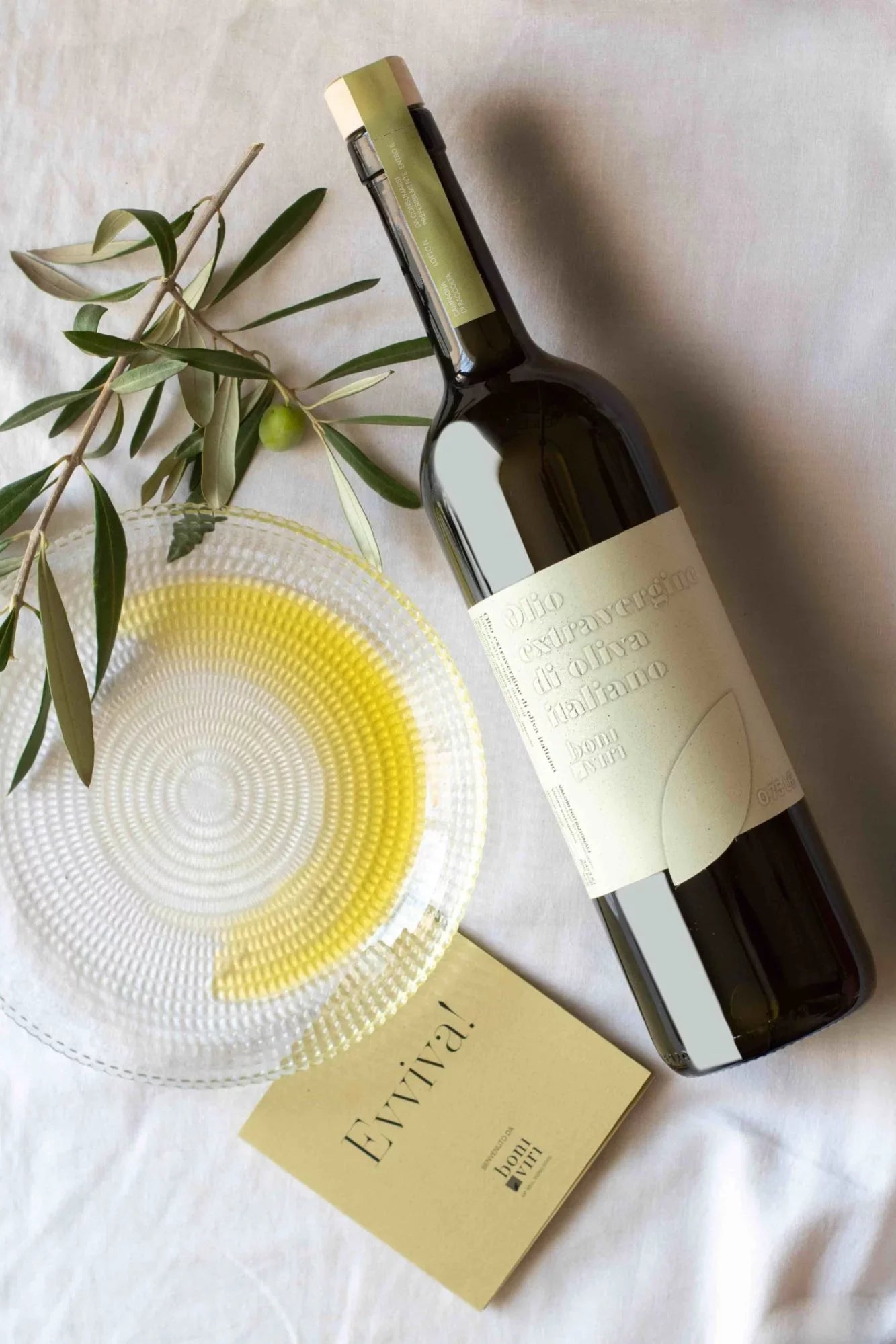
For the packaging, we started with one goal: to choose the best materials for quality and safety, with a focus on sustainability and waste reduction.
The packaging of extra virgin olive oil represents an interesting challenge in terms of sustainability.
In this regard, the criteria for choosing the packaging are linked to various considerations, such as weight, the sustainability of the source materials, their recyclability, and the oil’s preservation properties.
When selecting the right packaging for Boniviri oil, we reconsidered traditional choices, keeping only the necessary elements and simplifying the complexity often created by marketing needs. Our choices started from one goal: to choose the best materials for quality and safety, with a focus on sustainability and waste reduction.
The first choice concerns the container par excellence: glass.
Although it is a heavier material compared to plastic and aluminum (and therefore has a greater impact in terms of greenhouse gas emissions related to transport), glass is the best material for preserving oil because it is inert and does not allow components to pass between the container and the contents (as plastic does).
In this case, our choice was based on quality and safety. However, to reduce greenhouse gas emissions, we chose to purchase bottles from the glassworks closest to us: in Marsala, Sicily, to reduce the impact of transportation. To reduce the product-to-packaging ratio, compared to the traditional 500 ml bottle, we chose a 250 ml bottle, sufficient for about two weeks of consumption, to reduce waste and encourage more conscious use.
For the cap, we chose an aluminum cap with a plastic seal, a material that is easily recyclable and has good sealing capacity. We avoided using plastic caps, which are less recyclable and have a greater impact in terms of production and disposal.
For the label, we chose a recycled paper material with water-based inks to reduce environmental impact. Additionally, we opted for a simple and clear design to communicate transparently and directly with the consumer.
Finally, for the outer packaging, we chose boxes made of recycled cardboard, with minimalist graphics and no use of plastic. The boxes were designed to protect the product during transport, minimizing material use and facilitating recycling.
In this way, we sought to reconcile quality, safety, and sustainability to offer a product that respects the environment and promotes more conscious consumption.