

How has honey been preserved in Egyptian tombs until today? How do bees produce it from nectar? In this article, we answer some of these questions. common questions and curiosities about honey, exploring its benefits, discovering why this unique food never spoils and why its crystallization is a sign of quality.
What is honey and how is it produced?
Honey is the product of digestion of nectar from flowers collected by the bees. Its production begins with forager bees, adult worker bees flying from flower to flower to collect nectar, a sugary substance produced by flowers to attract pollinating insects. The bees suck it up and store it, beginning to transform it already during the flight back to the hive thanks to enzymes that break down complex sugars (sucrose) into simple sugars (glucose and fructose). This process lowers the pH and changes the chemical composition of the nectar, beginning to make it more stable and less prone to fermentation. Once they return to the hive, forager bees transfer nectar from bee to bee by enrich it with additional enzymes. The partially transformed nectar is then deposited in the hexagonal cellsof the hive, where it goes from liquid and still rich in water it becomes stable and storable work from the ventilating bees which create warm and dry air currents by beating their wings, and promoting the evaporation of water until its content is reduced to about 16-23%.
When the honey has reached the proper consistency and moisture, the bees seal the cells with a wax cap, to protect and preserve it as food reserve for winter or periods of flower scarcity. The beekeeper extracts the honey from the honey super, the upper part of the hive dedicated to excess honey production according to the needs of the hive.
What are the benefits of honey?
Honey contains compounds with natural antibacterial and antimicrobial properties, useful for fighting infections, promoting wound healing, and preventing respiratory tract infections. Thanks to its emollient and soothing power, honey is an effective remedy against dry cough and throat irritation, a function also recognized by the World Health Organization. Less known, however, is its ability to stimulate the intestinal bacterial flora, improving digestion and helping to maintain the balance of the gut microbiota. Finally, the presence of flavonoids and polyphenols counteracts free radicals, helping to slow down cellular aging and reduce inflammation. It is therefore a true concentrate of virtues that make it a precious food.
Why doesn't honey expire?
For its chemical-physical characteristics honey is a hostile environment for the development of bacteria and molds and therefore its preservability is virtually unlimited. Proof of this is evidenced by the discovery of containers filled with honey in perfect preservation condition in the Egyptian tombs dating back thousands of years. Here are the characteristics of honey that allow such a stable and long shelf life:
- Low water content: honey contains about 17% water, an amount too low to allow bacteria and molds to survive and multiply.
- Low pH: the pH of honey ranges between 3 and 4.5, a value that slows or inhibits the growth of many bacteria.
- Presence of hydrogen peroxide: it is a powerful antimicrobial agent that denatures bacterial proteins and prevents the proliferation of microorganisms.
These factors, combined with the fact that honey is hygroscopic (meaning it can absorb moisture from the environment), make it a naturally preservable food for very long periods.
Why does honey crystallize?
Honey is a a saturated sugar solution, especially glucose and fructose, dissolved in a small amount of water. Between the two, glucose is less soluble in water compared to fructose and tends to separate from the liquid part forming crystals. When the glucose concentration is high compared to fructose, glucose precipitates and triggers crystallization. It is therefore a a natural phenomenon determined by genuine presence of sugars in honey. Not only that, crystallization is a a desirable characteristic which indicates product purity, in fact does not occur in altered honeys or that have undergone industrial processes that compromised their original characteristics (e.g., excessive heating or dilution with sugar syrups). Also, crystallized honey can be easily returned to a liquid state gently warming it in a water bath at temperatures below 40°C to preserve its properties.
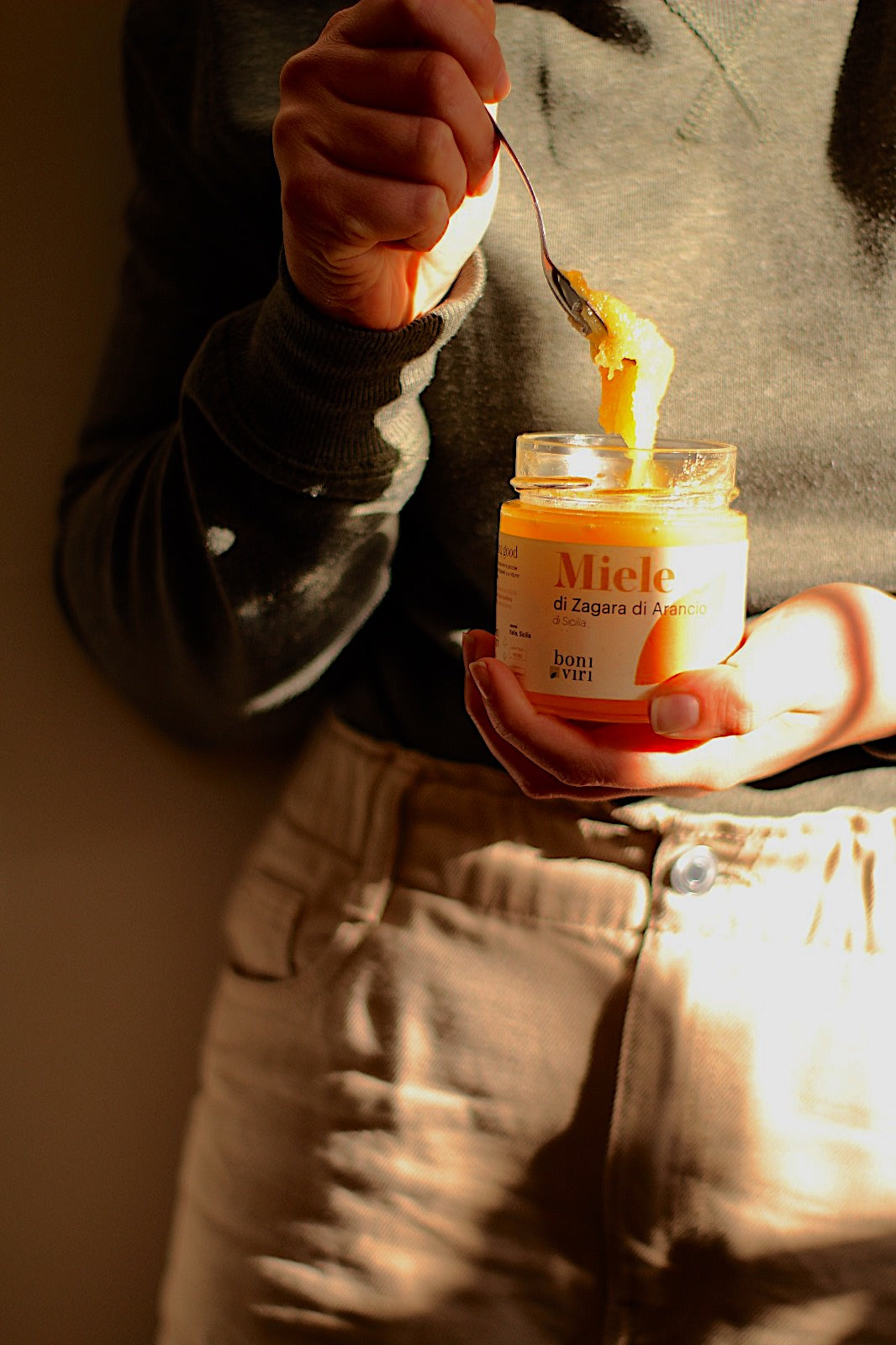
The honeys of Boniviri, of Chestnut, of Wildflower and of Orange Blossom, are produced byArtale Natura farm by Rosario Ferrara from Furci Siculo (ME). Rosario's honey is organic, raw, unpasteurized and protects biodiversity by safeguarding the Sicilian black bee, a species at risk of extinction that, thanks to the efforts of beekeepers like Rosario, can grow and reproduce without the stresses of intensive production methods.